



This blog post continues my research into Japanese Canadian records. If you’re reading this for the first time, you may want to read my earlier post on The Office of the Custodian of Enemy Property.
Last week, I shared with you how to find names in the card catalog. This week, we will dig deeper and I’ll show you how to use the information from the card catalog to find the case files.
What is a card file?
The card catalog contains biographical data on the Japanese Canadians: their names, addresses, file #’s, family members, family member file #’s, and occasionally notations on the status of the person. Think of it like a library card catalog and you have the idea: one goes to the card catalog first to find the file information, then to the file(s).


What is in a Case File?
In my research, I found the Case Files to be collected forms and documents pertaining to the expropriation, intake and internment of Japanese Canadians. They may contain: RCMP reports, statements of property, mortgage documents, house photos, probate, insurance, internee files, storage invoices, transport invoices, letters, legal correspondence, business documents, appraisals, Property Loss Claims, life insurance, newspaper clippings, Prisoner of War letters, Lists of chattels sold, handwritten notes and photos.
The documents vary by file, not all files contain the same documents or the same number of documents. Some files have hundreds of pages, others only a few. The quality of the microfilming varies widely – most are legible but unfortunately, many are too dark to read.
The preceding list is from my own research notes.
What you’ll need
If you have 2 or more screens, this is a good time to use them. To navigate these files, you’ll need 3 windows open:
Step 1 – Visit Héritage Canadiana for the card catalog
Go to Héritage Canadiana. Find your ancestors using the below guide to the 25,000+ cards on file:
C-9299 – 5044 images – ABE to INOSE
- Image 2: file 14775, ABE Akira (see image above)
- image 500: AOKI Midori, file 6827
- image 1000: [file # illegible] BANNO M.
- Image 1050 – Cameron Lake Logging Co.; Japanese owned
- image 1500: file 1542, ERAUT, Edith Maude
- image 2000: file 420, [hard to read] FUJIWARA, Toshiyuki
- Image 2500: file 13236, GOTO Shosuke
- image 3000: file 811, formerly file 586, HARADA Yoshio, Terra Nova Cannery
- image 3500: [no file # for head of family but file numbers for 3 family members] HAYASHI Tsunejiro
- image 4000: file 13236, HIRONAKA Yoshino
- image 4500: file 9691 IDE Mutsu
- image 5000: file 13212 INAMOTO Mitsu
- image 5044 [last image in reel set]: file 13255 INOSE Shiosaburo
C-9300 – 3335 images – INOSE to KOBAYASHI
- Image 2: INOSE Taiji, file 2996
- image 500: [no file #] GARROW, George and MENZIES, Hal, both of Pacific Co-Operative Union [scanned upside down]
- Image 1000: KABAYAMA Eiko, file 941
- image 1500: file G/191, KANAI Nobuye
- image 2000: file 2368 KAWAGOYE, Kiyoshi, E
- image 2500: [no file number] KIKUCHI, Shuzo
- image 3000: file 7675 KITAGAWA Yoshio
- image 3355 last image in set: [faint, hard to make out]
C-9301 – 5219 images – KOBAYASHI to NAKAO
- image 2: KOBAYASHI Seijiro file 14788
- image 500: KONO Satsu [no file #]
- image 1000: file 7361, KAMAMOTO [blurred]
- image 1500: file 13236 MAEHARA Ayame
- image 2000: image 2000: file 9887, [M—?, blurred]
- image 2500: file 6602, MIKI, Kiyo
- Image 3000: [file #blurred] MIYASHITA Mitsuo
- image 3500: file 7365 MORIKAWA Tam???? [id’d by consulting previous card]
- image 4000: file 1364, MURAKAMI K
- image 4500: [file #?4820 or 5820 maybe] NAGATA Harunori
- image 5000: Int. 1303, NAKAMURA Shizue
- image 5219 [last image in reel set]: file 3043, NAKAO, Yuriko
C-9302 4153 images – NAKASHIBA to SANO
- image 1: file 3387, NAKASHIBA Kumazo
- image 500: [no file #, reg#15429] NICOLAU Chika [married to a non-Japanese]
- image 1000: file 10918 NISHIMURA, Hideo
- image 1500: file 5430, NOMURA, Toshiharu
- image 2000: file 9306, OHASHI, Toki
- image 2500: file 8318, OKAZAKI, Shinako
- image 3000: file 8716, YAMAMOTO, Utaro [card upside down but may be turned to read]
- image 3500: file 11596, RYUJIN, Takeharu [card upside down but may be turned to read]
- image 4000: file 2901 SAKI, H
- image 4153 [last image in reel set]: file 7374, SANO, Aiko
C-9303 5222 images – SANO to URASE
- image 2: file 7853, SANO Chiyoko
- image 500: [no file #] SEKITANI Mrs. H.
- image 1000: file 12814 SHIMOKURA, Mitsugi Harold
- image 1500: file 11902, SOMIYA, Masao
- image 2000: file 1421, SUZUKI Itaro
- image 2500: file 4486, TAKAHASHI Sai
- image 3000: file 9410, TAKEUCHI Yonekichi
- image 3500: file 13236, TANAKA Sono
- image 4000: file 2371, TERAKAWA Tadaji
- image 4500: file 444, TSUBONE, Todon
- image 5000: file 310, UEDA, Isosaburo
- image 5222 [last image in reel set]: image 6446, URASE, Toki
C-9304 3011 images – URASE to ZIEGLER
- image 2: file 3141, URATA Kisaburo
- image 500: [file #blurred] WASHIMOTO Miss Lily
- image 1000: file 2635, YAMAMOTO Haruye Mrs. Katsuchi
- image 1500: file 4695, YAMASHITA Sumie
- image 2000: file 4437, YOSHIDA Kiyoko Miss (now Mrs. Juichi TSUJI)
- image 2348 [last of the card catalog by alphabetical names]: file 1544, ZIEGLER Gustav
Step 2 – Gather the information on the cards
Transcribe all the information on the cards for your family of interest. I would advise transcribing / collecting every matching name, even if at first you don’t recognize them. If you like, download a copy for your files (and don’t forget to note the information for your citations).
Be careful to note the file number carefully. It is the key to the Case File.
Step 3 – Go to Library and Archives Canada for the Case File finding aid
Consult the finding aid. You may wish to save a copy. Please note I have not provided it here for you as it is copyrighted material and owned by LAC.


Finding Aid 117-6
Finding Aid 117-6 is dated 5 May 1952. The aid will give you a list of the microfilm reels for the fonds of the OCEP, Vancouver Office Records that are located at LAC. Unfortunately, not every reel is currently available at Héritage Canadiana. See below.
Reel list and descriptions
- C-9299-9304: See above for descriptions of the card catalog files
- C-9310: From Case Files-681, Pt. 2 to Case Files-735 – For this set, I took the time to review all 1955 images to give you a quick reference for the 78 Case Files in this reel:
-
image 1:“681 continued” re: “Japanese Property Claims Commission”
-
image 4: “689” MIZUGUCHI Denkichi
-
image 42: “690” KANEGAWA Setsuo
-
image 57: “691” KOCHI Yohsio
-
image 118: “X.I. 681” TSUBOUCHI Kiyoshi
-
Image 183: “682” IKEDA Masatsuga Jack
-
image 190: “X.I. 682” TATEISHI Harukiko [some images scanned missing left hand side]
-
image 214: “683” SHINDE Isamu
-
image 254: “XI-683” TATEISHI Masahiko [some very dark images]
-
image 291: “684” IKEDA Terakichi [some very dark images]
-
image 450: “XI-684” TAKENAKA Eizo
-
image 465: “685” TSUCHIYA Tomotaro [some very dark images]
-
image 518: “686” TAKAHASHI Akira
-
image 527: “687” KARIYA Yone (Mrs.)
-
image 591: “688” KANEKO Heisuke
-
image 605: “689” MIZUGUCHI Denkichi
-
image 643: “690” KANEGAWA Setsuo
-
Image 658: “691” KOCHI Yoshio
-
image 719: “XI-691” UEYAMA Tamotsu
-
Image 724: “692” KANAYAMA Kimiko (Mrs. Shoichi)
-
image 731: “XI-692” UYENO Kiyoshi
-
image 778: “694” KANAYA Jiro
-
image 789: “XI-694” YOSHIKUNI Kazuo
-
image 808: “695” IZUMI Togiro
-
image 825: “XI-695” YAMASHITA Kenichi
-
image 845: “696” KANASHIRO Yasutaki
-
image 853: “697” NISHIHAMA Yonezo
-
image 886: “XI 697” YAMADA Jinye
-
image 891: “698” KANASHIRO Taro
-
image 901: “699” SHIMANO Matsuo [some very dark images]
-
image 940: “XI-699” YOSHIKUNI Eiichi [some very dark images]
-
image 960: “700” KANASHIGE Seiichi
-
image 973: “XI 700” YAMAMURA Kinijiro
-
image 985: “701” MURAKAMI Kamematsu [some very dark images]
-
image 1065: “702” KAMIMURA Otokichi [some very dark images]
-
image 1077: “XI-702” YOKOTA Tadayoshi [some very dark images]
-
image 1089: “703” SHIGA Hajime
-
image 1114: “704” KAMEDA Shigetoshi
-
image 1136: “XI-704” YOSHIDA Yoshikasu
-
image 1150: “705” ODA Kiyozo [some very dark images]
-
image 1200: “XI-705” YOSHIDA Isamu
-
image 1206: “706” KAMEDA Ritsuko [some very dark images]
-
image 1251: “XI-706” YOSHIKINI Kazumi
-
image 1275: 707” HIKIDA Gihei [some very dark images]
-
image 1323: “708” KAMEDA Harry Shigeo
-
image 1354: “709” HAYASHI Sadakichi
-
image 1428: “710” KAMEDA Masao
-
image 1440: “711” IWASAKI Akira
-
image 1494: “712” KAMAI, Kazuyasu
-
image 1499: “713” KUWAHARA Thomas Tadaaki
-
image 1505: “714” KAMACHI Shigekazu
-
Image 1522: “715” SHIMIZU Tsutomu
-
image 1533: “716” ENNYU (Moto) Mrs. Sannosuke
-
image 1536: “717” ONISHI Otokichi
-
image 1572: “718” KADOWAKI Tadashi
-
image 1586: “XI-718” MORI Takeo
-
image 1598: “719” HASIGAWA George Kyoshi
-
image 1608: “720” KADOWAKI Misao
-
image 1613: “721” NAGAI Toshiko
-
image 1624: “722” KADOWAKI Hiroshi
-
image 1629: “723” HASEGAWA Ayako
-
image 1647: “XI-723” YAMAMOTO Teizo
-
image 1686: “724” KADONAGA Tomojiro
-
image 1711: “725” OKAMOTO Sueco (Mary)
-
image 1716: “726” FUKAMI Tsunekichi
-
image 1727: “XI-726” ICHIIWA Masaji
-
image 1741: “727” NAKAMURA (Yaeki) Mrs. Shigaru
-
image 1749: “728” IZUMI Shimataro
-
image 1758: “XI-728” NODA Fukuya
-
image 1766: “729” NAKAMURA (Taki) Mrs. Shinkichi
-
image 1774: “XI-729” OKUBO Tanematsu
-
image 1782: “XI-730” NAKADA Katsumi
-
image 1797: “731” TAKAHASHI Hideo
-
image 1821: “XI-731” KAMBARA Tameo
-
image 1831: “732” IWASA Bunshiro
-
image 1866: “733” KUTSUKAKE Hisashi
-
image 1903: “734” IWANAME Bunyei
-
image 1914: “735” KOZUKI Fred Tokuhide
-
- C-9313: Case Files-881 to Case Files-XI-988, Pt. 1
- C-9314 to C-9325: not currently available on Héritage Canadiana
- C-9326: Case Files-1941 to Case Files-2084, Pt. 1
- C-9327: not currently available on Héritage Canadiana
- C-9328: Case Files-2231 to Case Files-2316
- C-9329 to C-9342: not currently available on Héritage Canadiana
- C-9343: Case Files-4206, Pt. 2 to Case Files-4331, Pt. 1
- C-9344 to C-9365: not currently available on Héritage Canadiana
- C-9366: Case Files-6549 to Case Files-6637
- C-9367 to C-9400: not currently available on Héritage Canadiana
- C-9401: Case Files-10,538 to Case Files-10,705
- C-9402: Case Files-10,706 to Case Files-10,783, Pt. 1
- C-9403 to C-9427: not currently available on Héritage Canadiana
- C:9428: Case Files-14,367 to Case Files-14,658
- C-9429 to C-9430: not currently available on Héritage Canadiana
- C-9431: Case Files-15,222 to Case Files-15,618
- C-9432 to C-9433: not currently available on Héritage Canadiana
- C-9434: Case Files-15,752, Pt. 2 to Case Files-15,752, Pt. 2
Step 4 – Use the card catalog and the case files
Compare the file numbers from Step 2. If they are included in the Case Files on Héritage Canadiana, there is a Case File to be found online.
You’ll have to go to the links to see these files – I provide the following images as examples of what you will find but am mindful of both sensitive information of people who may still be living AND attempting to find a balance between educating and respecting copyrighted materials.
Example No. 1: SHIGA Hajime
The name SHIGA can be found on Reel-9303 between image #500 “SEKITANI” and image #1000 “SHIMOKURA.” Going to image #500 and scrolling through, we find SHIGA Hajime at image #646. In the top left hand corner, we see file #703.

Referring to the Case File list above, we can see Case File #703 is in Reel C-9310, image #1089. Case Files #4050, #9987, and #7711 are not available here but you may be able to acquire it from LAC. See below.
Example #2: YASHIMURA Masakiyo
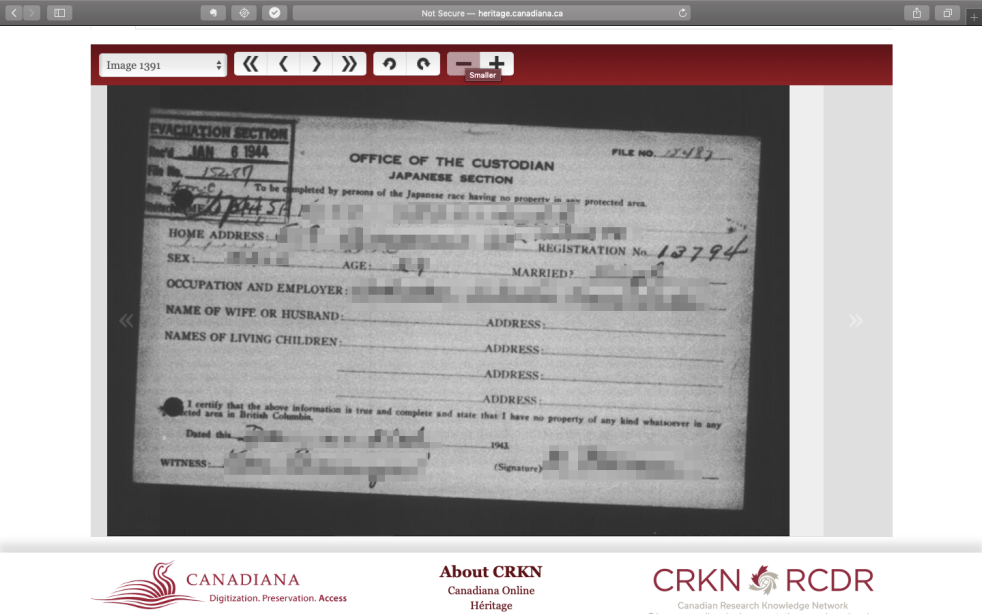
We find YASHIMURA Masakiyo in Reel C-9304, between image #1500 “YAMASHITA” and image #2000 “YOSHIDA, at image #1714. It is Case File #15,487 (upper top left corner).

To find the Case File, we go to Reel C-9431. This reel begins at Case File #15,222 and ends at 15,618, so I begin looking at image #1000. We find Case File #15,487 beginning at image #1390.
I found my card file but my case file isn’t here – what do I do now?
Thanks to Victoria for her suggestion on what to do next (see comment below). The reels that are not digitized are currently restricted and only available through an Access to Information Act request. Additionally, they appear to be governed by laws similiar to vital statistics records. You will need either permission from the person if living, or if deceased, either proof of death over 20 years / proof of birth over 110 years ago.
You may also contact the Japanese Canadian National Museum. I met the archivist, Linda Reid, by phone this week and she is friendly, helpful and oh, so knowledgeable.
Will the other case files be available online at some point?
I spoke with Linda Reid, archivist at the Japanese Canadian National Museum in Burnaby, BC. She told me about the Landscapes of Injustice Project, a multi-year, multi-million dollar project on the history of Japanese internment. My understanding from our call is that more and better archives are coming, perhaps as early as 2021.
Postscript
Probably because I am not an archivist, I found it both confusing and maddening to navigate these two sites: Héritage, which had the digital images, and LAC, which had the descriptions but no obvious way to refer to the fonds at The Office of the Custodian of Enemy Property.
It wasn’t until I spent 3 hours patiently going through every hierarchy and sub-file at LAC and building myself a reference map that it began to make sense to me. Of course, once I’d done that, I found the “Finding Aids.” If I keep going, I might even find the original file that led me down this rabbit hole: the file on my grandfather’s store, Wing Wah Company. What I did find interesting is that LAC is doing a lot of work digitizing its finding aids. There are at least 8 sub-sub files that have replaced the old paper finding aids with digital, cross-referenced descriptions. Here’s my rough sketch.
Map of the fonds – Office of the Custodian of Enemy Property

Thank you
This has been quite the eye-opening week. Thank you to the members of my Facebook group Genealogy for Asian Canadians Mika Local, Linda Harms Okazaki, Kimiko Karpoff and Marisa Louie, for your collective thoughts and conversation. Also thank you to Linda Reid, archivist at the Japanese Canadian Museum National Museum for her help this week. Come join the conversation.